IHS Realignment
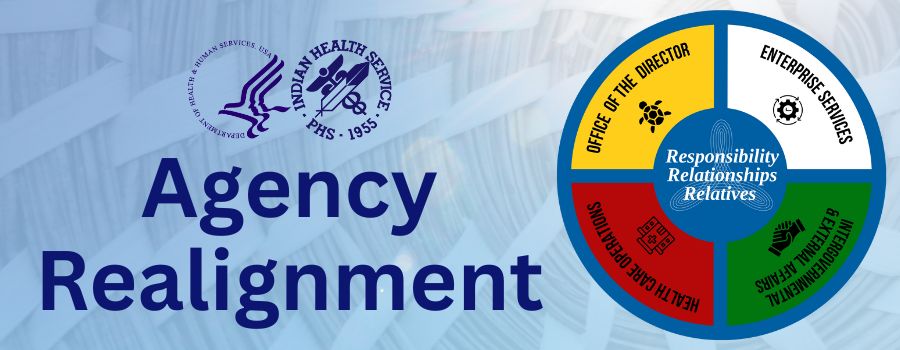
June 13, 2025 Realignment Dear Tribal Leader Letter: The IHS Acting Director writes to Tribal Leaders and Urban Indian Organization Leaders to initiate Tribal Consultation and Urban Confer to seek your recommendations regarding the proposed realignment of the Indian Health Service.
August 6, 2025 Realignment Dear Tribal Leader Letter: The IHS Acting Director writes to Tribal Leaders and Urban Indian Organization Leaders in follow-up to the June 13 letter and to notify you of additional information available on the IHS website regarding the IHS Strategic Realignment. The letter also includes a reminder to Tribal Leaders about the opportunity to contribute to the IHS Hall of Tribal Nations display.
December 5, 2025 Realignment Dear Tribal Leader Letter: The IHS Chief of Staff writes to Tribal Leaders and Urban Indian Organization Leaders to announce an expanded schedule of Tribal Consultations and Urban Confer to seek your engagement on the proposed IHS realignment.
February 23, 2026: Realignment Dear ANHB Letter: The IHS Acting Director responds to Alaska Native Health Board request for in-person Tribal Consultation in Alaska regarding the proposed IHS Realignment.
Overview
The Indian Health Service (IHS) is undertaking a strategic modernization appropriate for the 18th largest health system in the United States by aligning the agency’s structure with its statutory requirements and operational realities. The IHS has not undertaken a strategic review of its organizational structure in 20 years. In that time, the Indian health system changed dramatically. Currently, Tribes directly operate 65 percent of the IHS budget under the Indian Self-Determination and Education Assistance Act (ISDEAA) making it all the more critical for IHS to evaluate how it stewards the remaining 35 percent of the IHS budget intended for IHS-run health care facilities.
The realignment aims to modernize the agency’s organizational structure, creating a more nimble organization that can adapt easily to its dynamic future. The IHS is proposing to realign its organization and functions to achieve the following goals:
- Strengthen Patient-Centered Care
- Advance Tribal Self-Determination
- Modernize Enterprise Services and Functions
Tribal Engagement
The schedule of round 2 of realignment-focused tribal consultations and confers was shared via Dear Tribal Leader Letter on December 5, 2025. Dates include:
- December 15, 2025 Tribal Consultation–Durant, OK
- December 16, 2025 Tribal Consultation–Denver, CO
- December 17, 2025 Tribal Consultation–San Diego, CA
- December 22, 2025 Tribal Consultation–Virtual
- January 5, 2026 Tribal Consultation–Flagstaff, AZ
- January 6, 2026 Tribal Consultation–Seattle, WA
- January 7, 2026 Tribal Consultation–Billings, MT
- January 8, 2026 Tribal Consultation–Green Bay, WI
- January 15, 2026 Urban Confer Session–Virtual
Additional information, including specific locations and times, how to register, and deadlines for submitting comments can be found on the IHS website calendar.
Previously, round 1 of tribal engagement kicked off with a June 13, 2025 Dear Tribal Leader Letter. The following six months of engagement included the following tribal consultations, urban confers, listening sessions, senior leadership speaking engagements, and town halls, where information was shared and input solicited:
- June 6, 2025: National Congress of American Indians Mid-Year–Mashantucket, CT
- June 17, 2025: Tribal Leaders Diabetes Committee Meeting–Virtual
- June 25, 2025: IHS Director’s Workgroup on Improving Purchased/Referred Care–Minneapolis, MN
- July 8, 2025: Tribal Consultation: IHS Strategic Realignment–Seattle, WA
- July 9, 2025: Northwest Portland Area Indian Health Board Quarterly Meeting–Portland, OR
- July 10, 2025: Tribal Consultation: IHS Strategic Realignment–Phoenix, AZ
- July 15, 2025: Tribal Consultation: IHS Strategic Realignment–Minneapolis, MN
- July 17, 2025: Quarterly Albuquerque Area Tribal Consultation and Urban Confer–Albuquerque, NM
- July 23, 2025: Tribal Consultation: IHS Strategic Realignment–Washington, DC
- July 23, 2025: TSGAC Meeting–Washington, DC
- July 28, 2025: IHS Urban Confer–Virtual
- August 6, 2025: Alaska Native Health Board Mega Meeting–Anchorage, AK
- August 12, 2025: IHS Employee Town Hall–Virtual
- August 12, 2025: Facilities Appropriations Advisory Board–Virtual
- August 21, 2025: IHS Employee Town Hall–Virtual
- August 27, 2025: IHS Employee Town Hall–Virtual
- September 5, 2025: Great Plains Tribal Leaders Health Board–Bismarck, ND
- September 8, 2025: National Indian Health Board Conference–Chandler, AZ
- September 16, 2025: Tribal Leaders Diabetes Committee Meeting–Arlington, VA
- September 18, 2025: Association of American Indian Physician Annual Meeting–Seattle, WA
- September 23, 2025: HHS Secretary’s Tribal Advisory Committee and DSTAC–Aquinnah, MA
- October 1, 2025: Northwest Portland Area Indian Health Board Meeting–Portland, OR
- October 21, 2025: IHS Facilities Appropriations Advisory Board–Virtual
- October 29, 2025: IHS Area Tribal Budget Formulation–Tucson, AZ
- November 4, 2025: IHS Area Tribal Budget Formulation–Nashville, TN
- November 5, 2025: National Indian Health Board Meeting–Washington, DC
- November 7, 2025: Albuquerque Area Tribal Consultation and Urban Confer–Albuquerque, NM
- November 12, 2025: Navajo Area Tribal Budget Formulation Meeting–Flagstaff, AZ
- November 14, 2025: IHS Portland Area Tribal Budget Formulation–Portland, OR
- November 18, 2025: IHS Bemidji Area Tribal Budget Formulation–Baraboo, WI
- November 18, 2025: IHS Billings Area Tribal Budget Formulation–Billings, ND
- November 19, 2025: IHS Nashville Area Tribal Budget Formulation–Nashville, TN
- November 20, 2025: IHS Oklahoma City Area Tribal Budget Formulation–Oklahoma City, OK
- November 21, 2025: National Congress of American Indians–Seattle, WA
- December 2, 2025: Office of Resource Access and Partnerships End-of-Year Meeting–Rockville, MD
- December 2, 2025: Tribal Leaders Diabetes Committee Meeting–Virtual
- December 2, 2025: IHS Phoenix Area Tribal Budget Formulation–Phoenix, AZ
- December 9, 2025: IHS California Area Tribal Budget Formulation–Sacramento, CA
- December 10, 2025: Tribal Self Governance Advisory Committee Meeting–Washington, DC
More than 400 participants from more than 40 Tribes and urban Indian organizations provided critical feedback during round 1.
Frequently Asked Questions
Updated: January 2, 2026
Why is the IHS proposing these changes?
The current structure has not been substantially modernized in decades, even as the health care environment, workforce expectations, and the agency’s operating context have changed—especially with the continued growth and maturity of self-governance. As a result, the IHS leadership team is proposing to update our organizational structure in coordination with Tribal nations and urban Indian organizations to better execute the agency’s mission and federal trust responsibilities.
The proposed realignment is designed to strengthen accountability, improve operational support to federal service units, and reduce variation in how we deliver and manage care across the country. It will also strengthen direct patient care, advance Tribal self-governance and self-determination, and modernize core business functions to efficiently support the agency’s operations. The realignment proposal addresses the reality that 65 percent of the IHS budget is directly operated by Tribes, and that amount is growing. It also prepares the agency to more easily adapt to future developments in health care and increasing ISDEAA contracting and compacting.
The proposed realignment will create a more patient-centered, self-determination-driven, operationally efficient, and fiscally sustainable health care systems. It supports the Tribal sovereignty of all Tribes by deepening our partnerships with both direct serves and self-governance Tribes. Taken together, the proposed changes are intended to modernize and improve the health care systems serving Indian Country and significantly enhance IHS support for the health and well-being of American Indians and Alaska Natives.
What meaningful Tribal consultation is occurring? How did you select locations for consultations and why isn’t my area included?
IHS is conducting this work in full compliance with its Tribal Consultation and Urban Confer (TC/UC) Policy and within the statutory and delegated authority of the agency. The Tribal consultation and urban confer process is essential to informing these changes, ensuring the structure strengthens relationships and supports better outcomes for patients and communities. To do so, the IHS has implemented a deliberate, multi-phase engagement strategy designed to both inform Tribal nations and urban Indian organizations and to solicit meaningful input on the proposed realignment.
IHS issued its first Dear Tribal Leader Letter in June 2025, followed by the first formal Tribal consultation in July 2025, to provide early notice and begin soliciting input. Between Round 1 and Round 2 of Tribal consultation and urban confer, IHS conducted in-person engagement across nine states and Washington, DC, ensuring broad geographic outreach.
During this same period, IHS executive leadership shared information about the proposed realignment and encouraged participation through additional engagements in eight other states. Both consultation rounds included virtual participation options, allowing Tribes and urban Indian organizations to engage regardless of location or travel constraints.
How does this realignment affect direct service Tribes? Self-governance Tribes?
Tribal nations exercise their self-determination by choosing to receive health care services directly from the Indian Health Services as a direct service Tribe, or by opting to become a self-governance Tribe—responsible for operating their own health care systems. IHS is responsible for, and prioritizes, supporting Tribal self-determination for all Tribes, regardless of which option they choose for their health care operations.
The proposed realignment improves health care systems for direct service Tribes to ensure consistent, high-quality health care across all IHS-operated hospitals and clinics. The realignment ensures that there are strong, uniform health care operations at all IHS-run facilities, irrespective of a direct service Tribe’s physical location, funding level, or population needs.
For self-governance Tribes, the realignment removes unnecessary burdens and obstacles to Tribes building and operating their own health care systems. From streamlining the negotiation process to re-focusing the government-to-government Tribal relations functions of area offices, the realignment aims to enhance Tribal sovereignty by clearing the way for self-governance Tribes to run efficient health care operations how they deem fit.
What does this mean for Tribal shares?
Tribal shares will remain fully intact under the proposed organizational structure. No reductions, changes, or reallocations are planned under the proposed organizational structure. The realignment will improve the agency’s tracking and management of Tribal shares, ensuring that all Tribal negotiations are transparent and fair.
Are staff reductions planned as part of the reorganization?
No. The IHS is not planning staff reductions. Every position is essential to sustaining and strengthening the services we provide. IHS aims to reduce the vacancy rate, not grow it.
How much will the realignment cost?
The proposed realignment is budget neutral and will be implemented with existing resources.
What is happening to my area office?
Area offices and area directors continue to play a critical role at the agency. Area offices will transition to area Tribal relations offices to preserve strong, local government-to-government relationships, and close coordination with health care operations in their area. There will be 11 area Tribal relations offices, with the Tucson Area merging with the Phoenix Area.
Are you consolidating the current 12 IHS Areas into 3 mega areas overseen by headquarters? Won’t that mean my area’s concerns will not get the attention they receive now?
This is an important question, and it is critical to clarify what is and is not being proposed.
The proposed three Health Care Operations (HCO) regions are designed to improve how we support and manage federal service units nationwide and is not a consolidation of 12 areas into three regions. HCO regions were defined to balance the number of federal service units, staff, and operational complexity—so that leadership’s span-of-responsibility is practical and that support is consistent and timely.
The HCO regions do not replace areas, nor do they eliminate area-level presence or relationships. They are intended to reduce reliance on headquarters, not increase it. By shifting health care operational oversight to the regional level, many decisions can be made more efficiently and closer to the point of service delivery, rather than being elevated to headquarters.
Then what is changing with our areas?
There are limited, targeted structural changes. The Tucson Area will merge with the Phoenix Area. In addition, area directors will now focus upon fostering strong Tribal relations. By reducing the administrative and operational minutiae that currently consume much of their time, area directors will have increased capacity to support Tribal sovereignty, strengthening government-to-government relationships, and improve responsiveness to Tribal priorities.
These changes are intended to enhance IHS’s ability to support Tribes regardless of how they choose to exercise their sovereignty, whether as self-governance Tribes or direct service Tribes.
How is the role of the area director changing?
Area directors will continue to be critical to agency and will serve in a Tribal relations role as the primary, local-level point of access to the agency for Tribes, Tribal organizations, UIOs, state and local governments and community members. Area directors will be the local level access point for inquiries related to agency programs, policies and activities.
Are functions and authorities performed by area directors vested by law?
No. Area directors do not possess authority vested directly by statute.
What is the source and limitation of authority exercised by IHS area directors?
IHS area directors do not have independent statutory authority to perform Indian Health Service functions. All authority exercised by area directors is derived solely from delegations issued by the IHS director. While area directors may exercise significant authority consistent with that of inferior officers, this authority does not originate in statute, exists only by virtue of formal delegation, and may be modified, limited, or withdrawn by the IHS director at any time.
Area directors may act only within the scope and limits expressly defined in current delegation instruments. As a result, changes to organizational structure or delegated functions are within the director’s authority, provided they are implemented consistently with applicable law and policy.
What changes and what stays the same for IHS-operated facilities?
The IHS will continue to operate hospitals, clinics, and residential treatment centers that remain federally managed. The realignment will modernize and enhance direct health care services by establishing direct lines of coordination between IHS-operated hospitals and clinics and IHS headquarters. This streamlined structure will eliminate unnecessary administrative burdens and allow health care providers to devote more time and attention to patient care. Patients and relatives should expect to see improvements in their overall experience, and the consistency of health care provided by the IHS.
How do the proposed changes take feedback from Tribal consultation and urban confer into account?
In the first round of engagement, more than 400 participants from more than 40 Tribes and urban Indian organizations provided critical feedback, from which emerged common areas of focus including health equity, funding priorities, operational needs, and governance structures.
Accordingly, the proposal:
- Centers government-to-government relationships with Tribes and maintains a strong local presence by transitioning area offices into Tribal relations offices;
- Keeps area lead negotiators in the field, while elevating them to IHS headquarters for consistent and transparent negotiations nation-wide; and
- Supports recruitment and retention of health care providers by alleviating administrative burden through a streamlined organizational structure.
What is the approval process for approval of the realignment? Can we extend the timeline to add more consultations?
The consultation process will not be extended beyond the current timeline. IHS is adhering to its established Tribal Consultation and Urban Confer Policy, which outlines the scope, duration, and procedural requirements for consultation.
The agency has met its obligations under that policy through multiple consultation rounds, listening sessions, leadership outreach, and virtual engagement opportunities. While IHS values Tribal input and carefully considers feedback received, the TC/UC Policy does not require consultation in all 12 IHS Areas, nor does it require that self-governance Tribes have decision-making authority over direct service Tribe operational matters.
The proposed realignment will proceed through the agency’s internal approval and governance processes following the conclusion of the consultation and confer period, with leadership considering input received as part of that process.
What steps will you take to measure the success of these changes?
The IHS will set key measures and metrics to evaluate the success of the proposed realignment and make real-time adjustments as necessary to meet the stated goals of the realignment.
How does this proposed realignment impact the reorganization of Intergovernmental and External Affairs that was effective January 8, 2025?
The January reorganization of Intergovernmental and External Affairs (IEA) is currently in place. This realignment proposes to bring in the agency negotiators and area directors into the IEA space. It also prepares the agency to more easily adapt to future developments in health care and increasing ISDEAA contracting and compacting.
Why are you centralizing agency negotiations?
Agency negotiation activities will remain at the area level to ensure local involvement. The realignment elevates agency negotiations by centralizing oversight of negotiation policies, protocols, systems, and accountability. These changes will ensure uniform, consistent, and supportive experiences for all Tribes in negotiations with IHS. Agency negotiators will work in teams and have dedicated support staff for effective, efficient negotiations activities.
Will ISDEAA negotiations be impacted by this reorganization?
No. Agency negotiations at the local level are critical to the agency. We have considered this concern from Tribal leaders and while reporting lines to headquarters will be new, activities at the local level will still be in place.
How will my Tribal community have direct access to the Indian Health Service?
The agency preserves and values the strong government-to-government relationships with Tribes and our responsibility to urban communities. The proposed realignment continues to be a direct access point at the local level. The proposed realignment will continue to strengthen Tribal consultation and urban confer activities at all levels of the organization.
Will the realignment affect urban health funding?
Contract and grant funding to UIOs will not be affected with this realignment.
Will Health IT be affected?
No. The proposed realignment does not include changes to Health Information Technology functions or governance.
Will technical support from IHS to UIOs still be available?
Area office support will continue to be available to provide technical assistance to UIOs, as needed.
Additional Information and Resources
Executive Narrative
Organization Chart—Draft
Realignment PowerPoint
Tribal Consultation and Urban Confer Summary
Updated 01/02/2026
